Dysfunctional Beliefs – (Part. 1 and 2)

Dysfunctional beliefs are negative and often irrational beliefs that individuals hold about themselves, others, or the world around them. These beliefs are characterized by their self-defeating nature and can lead to emotional distress, unhealthy behaviors, and impaired functioning in various areas of life.

Dysfunctional beliefs may be formed through various life experiences, such as traumatic events, negative feedback, or critical experiences with significant others. These beliefs can become deeply ingrained and difficult to change, and may continue to influence a person’s thoughts, emotions, and behaviors long after the initial experiences that led to their formation.

Examples of dysfunctional beliefs include “I am a failure,” “I am unlovable,” or “Everyone is out to get me.” These beliefs can be pervasive and may cause individuals to engage in negative behaviors, such as avoiding social situations, engaging in self-harm, or withdrawing from others.

Therapy and other forms of treatment can help individuals identify and challenge their dysfunctional beliefs, leading to improved self-esteem, reduced anxiety and depression symptoms, and greater overall well-being. Techniques such as cognitive restructuring, exposure therapy, and mindfulness can be effective in challenging and replacing negative beliefs with more adaptive and positive ones.

Here are some examples of dysfunctional beliefs:

  1. Catastrophizing: Believing that a minor setback or problem is a catastrophe, and that the worst possible outcome will occur. For example, “If I don’t get this job, my life will be ruined.”
  2. All-or-nothing thinking: Seeing things in black and white terms and ignoring the gray areas. For example, “If I can’t do this perfectly, then I might as well not do it at all.”
  3. Overgeneralization: Drawing sweeping conclusions based on one or a few isolated events. For example, “I didn’t get the promotion, so I’ll never be successful.”
  4. Personalization: Taking responsibility for things that are outside of one’s control. For example, “It’s all my fault that my partner is unhappy.”
  5. Should statements: Setting rigid and unrealistic expectations for oneself or others. For example, “I should be able to handle this on my own.”
  6. Emotional reasoning: Believing that one’s emotions are always based on reality. For example, “I feel anxious, so there must be something to be afraid of.”

These types of dysfunctional beliefs can contribute to negative thoughts, emotions, and behaviors. Challenging and replacing these beliefs with more realistic and adaptive ones can lead to improved mental health and well-being.

Dysfunctional Beliefs – (Part. 1 and 2) – Human: www.fedmartraining.com
Cognitive dissonance – (Part. 1 and 2)

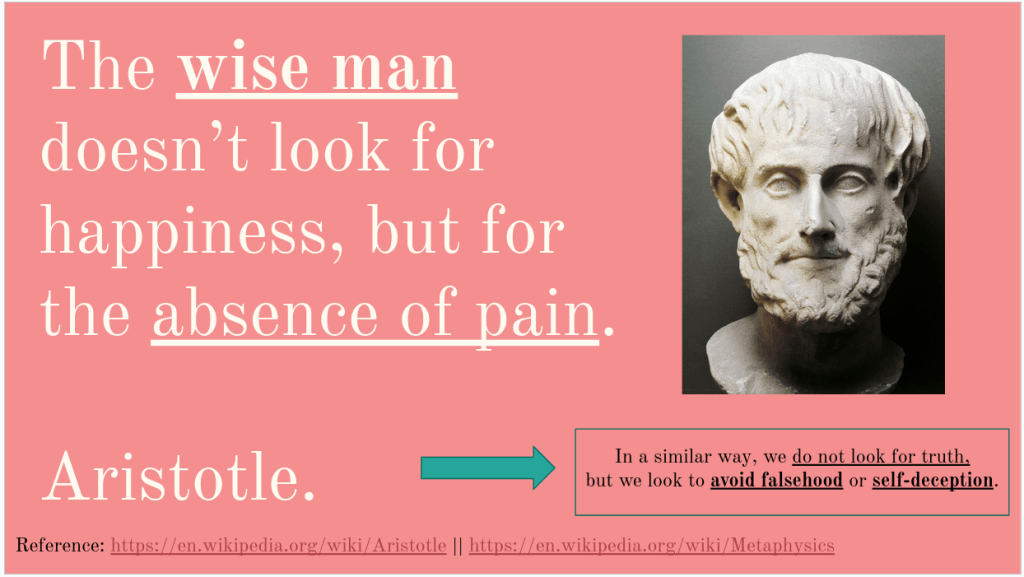
Cognitive dissonance is a psychological concept that describes the mental discomfort that arises when a person’s beliefs or attitudes conflict with their actions or with new information they encounter. It refers to the tension or discomfort that is felt when two cognitions (thoughts, beliefs, values, etc.) are inconsistent with each other.

When people experience cognitive dissonance, they may feel anxious, guilty, or conflicted. In order to reduce this discomfort, they may try to rationalize or justify their behavior, change their beliefs or attitudes, or avoid information or situations that create the conflict. However, if the dissonance persists, it can lead to feelings of stress, anxiety, and even depression.

Cognitive dissonance can occur in a variety of situations, such as when a person holds two conflicting beliefs, when a person’s behavior conflicts with their beliefs or values, or when a person receives new information that challenges their beliefs or attitudes. It is an important concept in the field of psychology and is often used to explain how people make decisions, form opinions, and justify their behavior.

Here are some additional examples of cognitive dissonances:

  1. Attitude-behavior inconsistency: When a person’s attitude toward a behavior is inconsistent with their behavior, such as believing that exercise is important but not engaging in regular physical activity.
  2. Self-perception: When a person’s perception of themselves conflicts with their behavior, such as believing they are honest but engaging in dishonest behavior.
  3. Selective exposure: When a person seeks out information that confirms their existing beliefs and avoids information that contradicts their beliefs.
  4. Choice justification: When a person justifies their choices or decisions, even if they go against their beliefs or values.
  5. Effort justification: When a person overvalues something they have worked hard to achieve, even if it is not actually that important or valuable.
  6. Belief disconfirmation: When a person’s beliefs are challenged by new information, causing discomfort or tension.
  7. Inconsistency between beliefs: When a person’s beliefs conflict with each other, causing discomfort or tension.
  8. Social pressure: When a person’s beliefs or behaviors are influenced by the expectations or opinions of others, even if it conflicts with their own beliefs or values.
  9. Rationalization: When a person justifies their actions or beliefs with logical or rational arguments, even if they are not actually logical or rational.
  10. Attitude change: When a person’s attitudes or beliefs change in response to new information or experiences, causing discomfort or tension.

Cognitive dissonance – (Part. 1 and 2) – Human: www.fedmartraining.com

Scapegoating – (Part. 1 and 2)

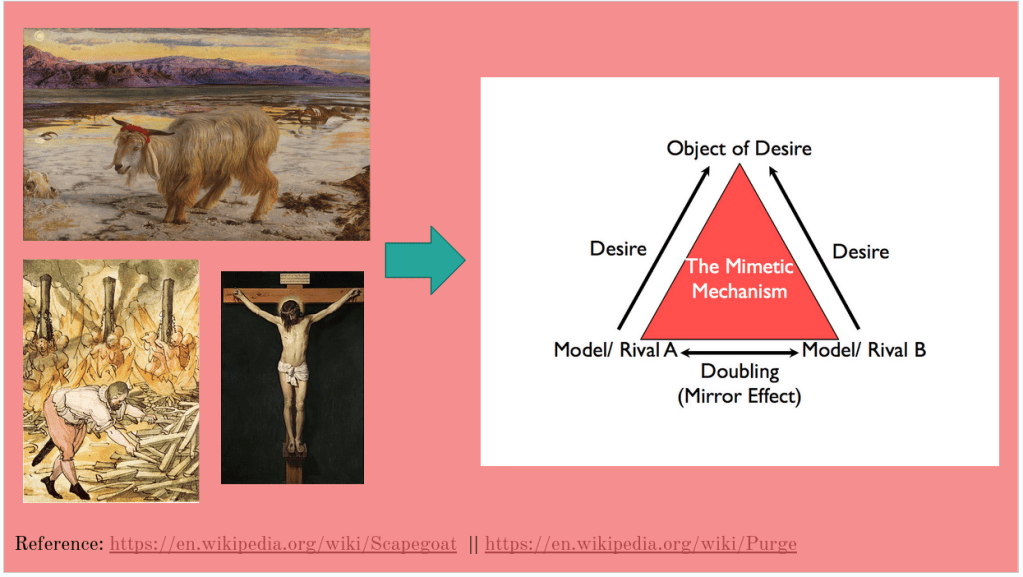
Scapegoating is a phenomenon in which a person or a group of people is blamed for problems, conflicts, or failures that are not entirely their fault. In this situation, the scapegoat becomes the target of collective anger, frustration, or resentment, and is unfairly held responsible for the problems of the group.

Scapegoating can occur in various settings, such as families, organizations, communities, and societies. It can take many forms, including ethnic or racial scapegoating, where a certain group of people is targeted based on their ethnicity or race, or organizational scapegoating, where an individual or group is blamed for the problems of an organization, even if they are not directly responsible.

Scapegoating is often used as a way of deflecting attention from the real sources of problems or conflicts, and it can serve to maintain the status quo or to reinforce existing power structures. It can have serious consequences for the person or group being scapegoated, including social exclusion, stigmatization, discrimination, and even violence.

It is important to recognize and challenge scapegoating behavior, and to promote a culture of accountability, where individuals and groups are held responsible for their actions, rather than unfairly blaming others for problems that are beyond their control.

Scapegoating practices can take many forms, and can occur in various settings, including families, organizations, communities, and societies. Here are some examples of scapegoating practices:

  1. Ethnic or racial scapegoating: Blaming a particular ethnic or racial group for problems in society or within an organization.
  2. Political scapegoating: Blaming a political party, leader, or ideology for problems in society or within an organization.
  3. Blaming the victim: Holding a victim of a crime, abuse, or harassment responsible for what happened to them.
  4. Workplace scapegoating: Blaming an individual or a department for problems within an organization, even if they are not directly responsible.
  5. Family scapegoating: Blaming one family member for problems within the family or for the dysfunction of the family.
  6. Religious scapegoating: Blaming a particular religion or religious group for problems in society or within an organization.
  7. National scapegoating: Blaming a particular nation or group of nations for problems in society or within an organization.
  8. Educational scapegoating: Blaming students, teachers, or educational institutions for problems within the education system.
  9. Economic scapegoating: Blaming a particular economic group or industry for economic problems in society.
  10. Environmental scapegoating: Blaming a particular group or industry for environmental problems in society.

It is important to recognize and challenge scapegoating practices, and to promote a culture of accountability, where individuals and groups are held responsible for their actions, rather than unfairly blaming others for problems that are beyond their control.

Mimetic Desire – (Part. 2)

Avoiding mimetic desires can be challenging, as they are often driven by social and cultural factors that are deeply ingrained in our psyches. However, here are some steps you can take to reduce the influence of mimetic desires in your life:

  1. Identify your own values and goals: Take time to reflect on what is truly important to you and what you want to achieve in life. This can help you to develop a sense of direction and purpose that is independent of external influences.
  2. Limit exposure to social media: Social media platforms are designed to promote the spread of mimetic desires. By limiting your exposure to social media, you can reduce the impact of these influences on your life.
  3. Seek out diverse perspectives: Engage with people who have different backgrounds, experiences, and values from your own. This can help you to broaden your perspective and develop a more nuanced understanding of the world.
  4. Practice mindfulness: Mindfulness practices such as meditation can help you to become more aware of your thoughts and emotions, allowing you to better recognize when mimetic desires are influencing your behavior.
  5. Cultivate gratitude: Focusing on gratitude for what you have rather than what you lack can help to reduce the influence of mimetic desires in your life. By appreciating what you have, you may find that you are less focused on acquiring what others desire.
  6. Practice delayed gratification: Learn to delay gratification by setting long-term goals and breaking them down into smaller, achievable steps. This can help you to avoid impulsive decisions driven by mimetic desires.

By taking these steps, you can become more aware of the influence of mimetic desires in your life and develop strategies to reduce their impact, allowing you to live a more fulfilling and authentic life.

Mimetic Desire – (Part. 2) – Human: www.fedmartraining.com
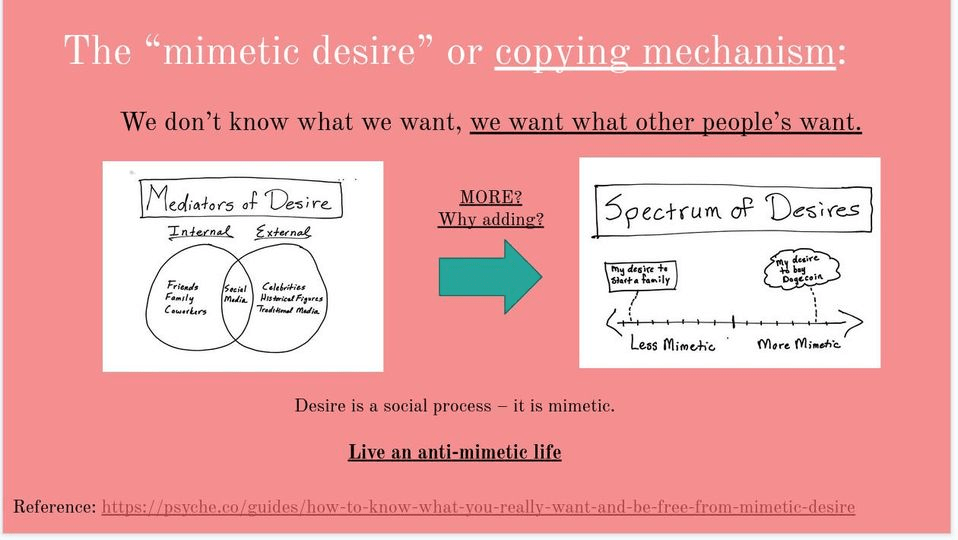
Mimetic desire – (Part. 1)

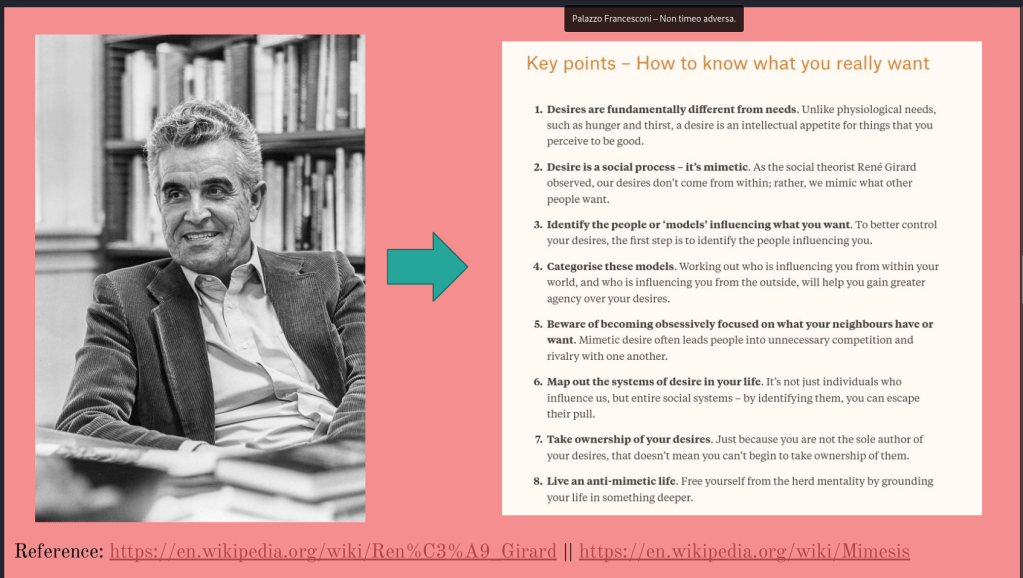
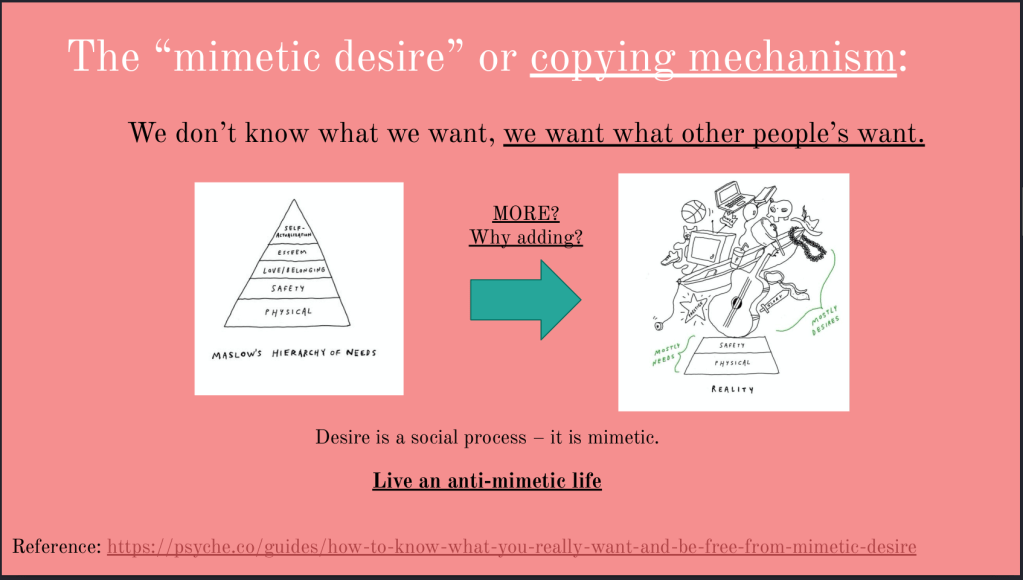
Mimetic desire is a concept in psychology and philosophy that refers to the tendency for people to imitate or desire what others around them desire. This idea was first introduced by French philosopher René Girard, who believed that our desires are often influenced by the desires of others, rather than being innate or personal.

According to Girard, humans have a natural tendency to imitate others, particularly those we admire or see as models for behavior. This imitation can extend to our desires, leading us to want what others want simply because they want it. This phenomenon is especially strong when it comes to desires that are seen as socially desirable or prestigious, such as material possessions, social status, or romantic partners.

Mimetic desire can have both positive and negative effects. On the one hand, it can be a source of social cohesion and shared values, as people bond over common desires and aspirations. On the other hand, it can lead to competition, conflict, and even violence when multiple people desire the same thing or when a desire becomes so strong that it overrides other considerations.

Overall, mimetic desire highlights the importance of social influences on our behavior and suggests that our desires are not entirely our own, but are shaped by the desires of those around us.

Mimetic Desire – (Part. 1) – Human: www.fedmartraining.com

Introduce Yourself

Hi, here’s Federico.

I am a serial entrepreneur, investor and human being.

My story is pretty long, but as for your interest I was born in Italy

in a small village near the Alps. I was always a very cheerful kid, until in high-school I had an existential crisis due to bullying and scapegoating.

I took some time to recover and my world view changed a lot in the meanwhile. I started my company CHANGE HOLDING OU to make alternative investments in emerging technologies and markets.

I started fedmartraining.com as a way to share what I have learned so far during this path of living on earth, falling to the ground and rising up again.

Hope I might help you solve your problems and grow together.

Sincerely,

Federico M.

Entrepreneur. Investor. Human. Reach your full creative potential.

Check what I do: https://linktr.ee/fedm_ar